

The Discounted Cash Flow (DCF) method is a powerful tool that helps you transform your vision into financial projections and evaluate the intrinsic value of your business. By discounting future cash flows to their present value, DCF provides you with a clear perspective on your business’s potential, independent of market fluctuations.
Are you facing a crucial decision for the future of your company? Whether you are planning an expansion, considering a major investment, or thinking about listing on the Bucharest Stock Exchange, you need a solid method to evaluate the financial impact of these decisions. Intuition and experience are important, but not sufficient. You need a rigorous analysis, a valuation of shares based on concrete figures, that shows you whether your decisions will create value in the long term.
For entrepreneurs who want to make informed decisions and maximize the value of their company, DCF is an indispensable strategic compass.
This method challenges you to think deeply about the future of your business: how revenues will evolve, what investments will be necessary, what the risks are, and how they are reflected in the cost of capital. Through this process, you will better understand not only the value of your business, but also the factors that influence it the most.
In the following sections of this article, we will explore in detail what the DCF method is, how it works, and how you can apply it in practice to make better strategic decisions.
Summary
- The DCF method evaluates a business by discounting future cash flows to their present value. It shows you the intrinsic value of the company based on the money it will generate, not on the market or comparisons.
- The quality of the valuation depends on the cash flow model and the financial projections. You must correctly estimate revenues, costs, investments, and free cash flow, over a realistic horizon, using well-founded assumptions.
- The discount rate and the terminal value decisively influence the result. WACC reflects the risk of the investment, and the terminal value can represent the majority of the total value, so the assumptions must be carefully set and tested through scenarios and sensitivity analysis.
Table of Contents
- What is the DCF method and why is it relevant for your business?
- What does DCF (Discounted Cash Flow) mean for obtaining the net present value of your business?
- Why is DCF considered one of the most credible valuation methods?
- Cash flow model – the foundation of DCF valuation
- The difference between profit and cash flow
- Calculation of free cash flow (FCF)
- Critical components of the model
- Financial projections: how to correctly forecast future cash flows?
- Setting the time horizon for projections
- Bottom-up methodology for revenue projection
- Projecting costs and expenses
- Common mistakes in projections and how to avoid them
- The discount rate that reflects the cost of capital: determining the discount rate for your company
- What is the discount rate and why is it essential?
- Calculation of the cost of equity
- Calculation of WACC (Weighted Average Cost of Capital)
- Particularities for Romanian companies
- Terminal value: calculating the residual value of the business
- The two main calculation methods
- Important checks and validations
- Practical steps for building a complete DCF model
- Steps for building the DCF model
- Sensitivity analysis: testing the robustness of your share valuation regarding investment returns
- Identifying variables with major impact
- Building complete scenarios
- Applying the DCF method for listed companies and preparation for listing on the BVB
- The role of DCF in the listing process
- Particularities for Romanian companies
- Common mistakes in applying the DCF method and how to avoid them
- The most common errors in applying DCF
- Checks to avoid errors
- Concrete steps for applying the DCF method
1. What is the DCF method and why is it relevant for your business?
1.1 What does DCF (Discounted Cash Flow) mean for obtaining the net present value of your business?
The Discounted Cash Flow method is based on a fundamental principle of finance: one leu received today is worth more than one leu received in five years. This difference in value reflects not only inflation, but also the opportunity cost, meaning what you could do with that money if you had it now, the risks associated with receiving it in the future, and the inherent uncertainty of any projection.
In essence, DCF allows you to estimate how much money your company will generate in the future and to transform these estimates into a present value, using a discount rate that reflects the risk of the investment.
The final result, the net present value, shows you whether your business creates value or destroys it, whether a planned investment is worth making, or whether the price asked for an acquisition is justified.
1.2 Why is DCF considered one of the most credible valuation methods?
Unlike other valuation methods that rely on comparisons with similar companies or on market multiples, DCF provides you with an intrinsic value based exclusively on your business’s ability to generate cash.
- This means that you are not dependent on market conditions or on recent transactions in the industry.
- You can evaluate a unique company, with an innovative business model, even if there are no direct comparables on the market.
For growing companies, this method is particularly valuable.
- If your business is investing heavily in development and current profits are modest or even negative, traditional methods based on profit multiples will not reflect the real potential.
- DCF allows you to capture the value created by these investments by projecting future cash flows, when the investments will begin to generate results.
The DCF method helps you answer essential strategic questions:
- Is it worth investing in a new production line?
- Is it the right time for an acquisition?
- At what price should you sell a part of the company to an investor?
- What is the fair value for listing on the stock exchange?
All these decisions require a clear understanding of the value created by your business, and DCF provides you with the analytical framework to arrive at well-founded answers.
In the following, we will explore how you can build a solid DCF model and how you can interpret the results to make better strategic decisions.
2. Cash flow model – the foundation of DCF valuation

Building a solid cash flow model is the cornerstone of any DCF valuation. This model must accurately reflect how your company generates and uses cash, starting from operating activities and extending to investments in assets and the financing structure.
2.1 The difference between profit and cash flow
The first element you need to understand is the difference between profit and cash flow.
A company may be profitable on paper, but still face liquidity problems if customers pay late, if inventories grow rapidly, or if investments in equipment are substantial.
That is why, in the DCF model, we do not use net profit, but free cash flow (Free Cash Flow), which shows how much cash remains available after you have covered all operating expenses and the investments necessary for maintaining and growing the business.
2.2 Calculation of free cash flow (FCF)
The calculation of free cash flow starts from operating profit (EBIT), from which you subtract taxes, add back non-cash expenses such as depreciation and amortization, then adjust for changes in working capital and subtract investments in fixed assets (CAPEX).
For a more detailed understanding of operating profitability indicators, you can also explore the in-depth details about EBITDA, how it is calculated and why it matters for your business.
Returning, the formula for calculating free cash flow (FCF) can be expressed as follows:
FCF = EBIT × (1 – Tax rate) + Depreciation + Amortization – Change in working capital – CAPEX.
NOPAT (Net operating profit after tax) is calculated as EBIT × (1 – Tax rate)
2.3 Critical components of the model
Working capital
- It can vary significantly depending on the business cycle.
- If your company is growing rapidly, it is likely that you will need more working capital to support growth: more inventory, more receivables to collect.
Investments in fixed assets
They must be separated into two categories: maintenance investments, necessary to preserve the current production capacity, and growth investments, which will allow the company to expand its operations.
Seasonality
If revenues vary significantly throughout the year, this will also affect cash flows.
A robust cash flow model must be sufficiently detailed to capture the specifics of your business, but not so complex that it becomes impossible to manage. For most companies, a model that projects revenues by main product or service categories, costs by functional categories, and investments by types of assets is sufficient to obtain a credible valuation.
When building the model, also pay attention to the seasonality of your business.
Also, consider the payment terms with customers and suppliers; these determine how long money remains tied up in receivables and trade payables, directly influencing the working capital required.
In the next section, we will explore how you can correctly project future cash flows, taking into account all these factors.
3. Financial projections: how to correctly forecast future cash flows?

The quality of your DCF valuation depends directly on the quality of the financial projections. This is where one of the greatest challenges arises: how do you estimate the future in an uncertain world, without falling into the trap of excessive optimism or unjustified pessimism?
3.1 Setting the time horizon for projections
The first step is to establish the time horizon for detailed projections.
- In general, a period of 5–10 years is used, long enough to capture the investment cycle and the maturation of the business, but not so long that the projections become pure speculation.
- For companies in early stages of growth, you can opt for 10 years, while for mature businesses, a period of 5 years may be sufficient.
3.2 Bottom-up methodology for revenue projection
Revenue projection must start from a deep understanding of your market.
- It is not enough to say “we will grow by 20% per year” without justifying where this growth will come from.
- You must analyze the size of the addressable market, the current market share and growth potential, the pricing strategy, plans for launching new products, and the operational capacity to support growth.
A useful method is to build the revenue projection bottom-up, starting from the fundamental units of your business.
- If you have an online store, you can project the number of visitors, the conversion rate, and the average order value.
- If you have a factory, you can project production capacity, utilization rate, and the selling price per unit.
This approach forces you to think concretely about the factors that drive revenues and makes the projections more credible.
3.3 Projecting costs and expenses
For costs and expenses, you must distinguish between variable costs, which increase proportionally with revenues, and fixed costs, which remain relatively constant.
Also, you must take into account economies of scale – as the business grows, certain costs per unit will decrease.
Profit margins do not remain constant over time; they evolve depending on the maturity of the business, competitive pressure, and operational efficiency.
3.4 Common mistakes in projections and how to avoid them
Projecting rapid growth indefinitely:
- No company can grow at 30% per year forever.
- As the business matures, the growth rate will converge toward the growth rate of the economy or the industry.
Ignoring macroeconomic factors: The evolution of GDP, inflation, exchange rates, legislative changes, or demographic trends can have a significant impact on future performance.
Lack of alternative scenarios: Build at least three scenarios: a base case (the most likely), an optimistic one, and a pessimistic one.
To test the robustness of your projections, vary the key assumptions (revenue growth rate, profit margins, required investments) and observe how the final value changes. This exercise will show you which factors are critical to the success of your business and where you need to focus your attention.
In the next section, we will discuss the discount rate, another fundamental element in DCF valuation, which reflects the risk of your investment.
4. The discount rate that reflects the cost of capital: determining the discount rate for your company
The discount rate is perhaps the most important and most debated parameter in the entire DCF valuation.
- This rate reflects the minimum return that investors expect in order to assume the risk of investing in your business.
- The higher the risk, the higher the discount rate must be, which will reduce the present value of future cash flows.
4.1 What is the discount rate and why is it essential?
For most companies, the discount rate is calculated using the weighted average cost of capital (WACC – Weighted Average Cost of Capital).
This method takes into account the fact that most companies are financed both through equity (shares) and debt (loans, bonds), each with its own specific cost.
4.2 Calculation of the cost of equity
The cost of equity reflects the return that shareholders expect and is usually calculated using the CAPM (Capital Asset Pricing Model).
The formula is:
Cost of equity = Risk-free rate + Beta × Market risk premium.
- The risk-free rate is usually the yield of long-term government bonds.
- Beta measures the volatility of your company’s shares relative to the market:
- a beta of 1 means that the shares move in line with the market;
- a beta greater than 1 means higher volatility.
- The market risk premium represents the additional return that investors require to invest in shares instead of government bonds.
For unlisted companies, determining beta is more complicated.
- You can use the average beta of listed companies in your industry, adjusted for differences in leverage.
- You must also add an additional risk premium for lack of liquidity – the shares of an unlisted company are harder to sell than those of a listed company
4.3 Calculation of WACC (Weighted Average Cost of Capital)
The cost of debt is easier to determine: it is the interest rate you pay on your loans, adjusted for the tax advantage (interest is tax-deductible).
If you pay 7% interest and the corporate tax rate is 16%, the effective cost of debt is 7% × (1 – 0.16) = 5.88%.
WACC is then calculated as a weighted average:
WACC = (E/V) × Cost of equity + (D/V) × Cost of debt × (1 – Tax rate), where:
- E is the value of equity;
- D is the value of debt;
- V is the total value (E + D).
The weights must reflect the target capital structure of the company, not necessarily the current structure.
4.4 Particularities for Romanian companies
In the Romanian context, you must take into account several specific factors.
- The market risk premium for Romania is higher than for developed markets, reflecting country risk.
- Also, for small and medium-sized companies, the cost of capital tends to be higher than for large companies, due to the additional risk associated with size and limited diversification.
An important aspect is adjusting the discount rate for the specific risks of your company.
- If your business depends on a single major client, if you operate in a highly competitive industry, or if you have a rigid cost structure, these risks must be reflected in a higher discount rate.
- Transparency in identifying and quantifying these risks will make your valuation more credible.
In the next section, we will explore how you can calculate the terminal value of your business, which represents a significant part of the total value.
- Terminal value: calculating the residual value of the business
After you have projected cash flows for the next 5–10 years, an essential question remains: what happens after that?
Your company will not disappear at the end of the projection period. The residual value or terminal value captures the value of all cash flows after the explicit projection period and, surprisingly for many, often represents 60–80% of the total value of the business.
5.1 The two main calculation methods
a) Perpetual growth method (Gordon Growth Model)
The first method assumes that the business will continue to generate cash flows indefinitely, growing at a constant rate.
The formula is simple: Terminal Value = FCF of the last year × (1 + g) / (WACC – g), where g is the perpetual growth rate.
Choosing the perpetual growth rate is crucial and must be done with caution.
- This rate cannot be higher than the long-term growth rate of the economy – usually between 2% and 4% for developed economies.
- For Romania, you can argue for a slightly higher rate, reflecting the potential for convergence with developed economies, but you must remain realistic.
- A rate of 3–5% is usually reasonable for most mature companies.
b) Exit multiple approach
The second method assumes that you will sell the business at the end of the projection period at a multiple of a financial indicator, usually EBITDA.
For example, if companies in your industry are traded at a multiple of 8× EBITDA and your projected EBITDA in the final year is RON 10 million lei, the terminal value would be RON 80 million.
- The advantage of the multiples method is that it reflects real market conditions and is easier for investors to understand.
- The disadvantage is that it introduces an element of circularity – you use market prices to determine value, which partially contradicts the DCF philosophy of calculating an intrinsic value independent of the market.
5.2 Important checks and validations
In practice, it is recommended to calculate the terminal value using both methods and compare the results. If the difference is significant, you must understand why and adjust the assumptions.
It is also useful to check what percentage of the total value is represented by the terminal value. If it is over 80–90%, it means that your valuation depends too much on assumptions about the distant future, which reduces the credibility of the analysis.
When using the perpetual growth method, make sure that the cash flow in the final year of the projection is normalized and sustainable. If the final year includes exceptional investments or unusual results, these will distort the terminal value.
Adjust the cash flow to reflect a “steady-state” level of the business, when growth has stabilized and investments are predominantly for maintenance.
6. Practical steps for building a complete DCF model
Now that you understand the theoretical components, let’s see how you can practically build a functional DCF model.
The process may seem intimidating at first, but by following a structured approach, you will be able to create a solid model that will support you in making strategic decisions.
6.1 Steps for building the DCF model
- Collecting and organizing historical data: Gather complete financial statements for the last 3–5 years (balance sheet, income statement, cash flow statement), information about investments in fixed assets, the evolution of working capital, and the financing structure.
- Building projections for the explicit period: Start with revenues, using the bottom-up methodology. Then project costs and expenses, taking into account the structure of fixed and variable costs.
- Calculating EBIT and NOPAT: Calculate EBIT (operating profit) and apply the tax rate to obtain NOPAT (Net Operating Profit After Tax).
- Adjustments for free cash flow: Add back depreciation and amortization, adjust for changes in working capital, and subtract investments in fixed assets (CAPEX).
- Discounting cash flows: Determine the discount rate (WACC) and discount each cash flow to present value using the formula: Present value = FCF / (1 + WACC)^n.
- Calculating terminal value: Use one of the discussed methods and discount it to present value.
- Final adjustments for equity value: Subtract net financial debt from enterprise value, add holdings in other companies, and adjust for other financial instruments.
The final result is the equity value, which, divided by the number of shares, gives you the value per share. This value represents your estimate of the intrinsic value of the company, based on its ability to generate future cash flows.
An important aspect is documenting all your assumptions.
- Create a separate section in your model where you list all key assumptions: growth rates, margins, investments, discount rate, perpetual growth rate.
- This transparency will make the model easier to understand and update, and will facilitate discussions with investors or advisors.
7. Sensitivity analysis: testing the robustness of your share valuation regarding investment returns
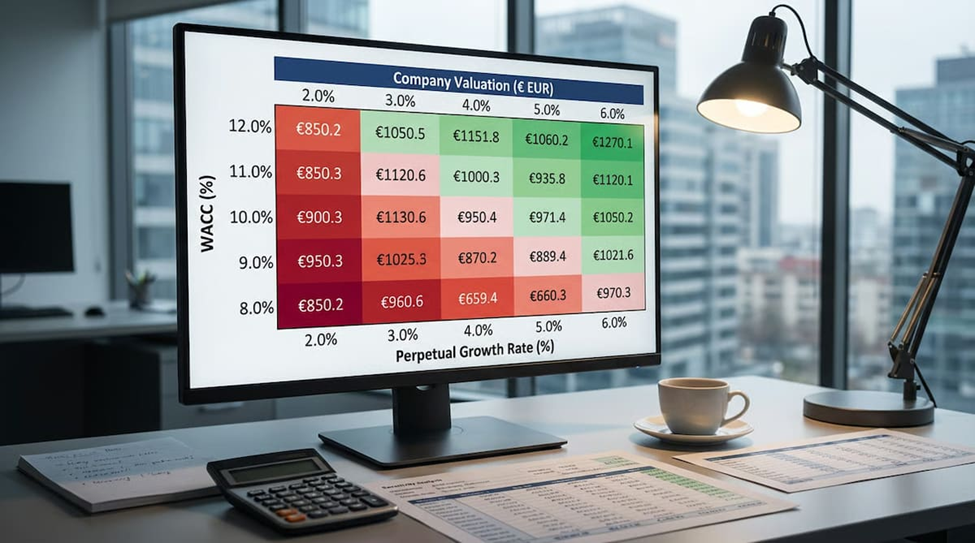
A DCF model is not complete without a sensitivity analysis that tests how robust your valuation is in the face of variations in key assumptions. This analysis shows you which factors have the greatest impact on value and helps you understand the range of possible values for your business.
7.1 Identifying variables with major impact
- Start by identifying the 2–3 variables with the greatest impact on the valuation. Usually, these are the revenue growth rate, the operating margin (EBIT margin), and the discount rate (WACC).
- Create a table in which you vary each of these variables by ±10–20% and observe how the final value changes.
For example, you can create a two-dimensional matrix that shows the company’s value for different combinations of growth rate and WACC.
- If the growth rate varies between 5% and 15%, and WACC between 8% and 12%, you will obtain 25 different scenarios (5×5) that show you the range of possible values.
- This matrix gives you a visual perspective on the sensitivity of your valuation.
7.2 Building complete scenarios
In addition to sensitivity analysis on individual variables, it is useful to build complete scenarios that combine coherent assumptions:
- Optimistic scenario: Rapid revenue growth, improvement in margins due to economies of scale, and a lower discount rate reflecting reduced risk.
- Base scenario: Realistic assumptions based on the financial analysis of the business and the market.
- Pessimistic scenario: Slow growth, pressure on margins due to competition, and a higher discount rate reflecting increased uncertainty.
This scenario-based approach is particularly useful when presenting the valuation to investors or to the board of directors.
- Instead of presenting a single figure that appears precise but is actually uncertain, you present a range of values with associated probabilities.
- This demonstrates that you have thought critically about your assumptions and that you understand the limitations of the model.
8. Applying the DCF method for listed companies and preparation for listing on the BVB

When preparing for listing on the Bucharest Stock Exchange, the DCF method becomes an essential tool in the process of setting the offer price. Unlike methods based on comparables, which can be influenced by temporary market conditions, DCF provides you with an anchor in the fundamentals of your business.
8.1 The role of DCF in the listing process
In the context of preparing for listing, the DCF valuation serves multiple purposes.
First, it provides you with a basis for negotiation with institutional investors in the bookbuilding process.
- You can demonstrate that the requested price is justified by the company’s ability to generate future cash flows.
- To ensure transparency of financial information and attract investors, a financial audit may be essential.
Secondly, it allows you to compare intrinsic value with the market value of similar companies already listed, identifying whether there is an opportunity to list at an attractive valuation.
8.2 Particularities for Romanian companies
Risk premium for the Romanian market:
- You must include a risk premium for the Romanian market, which reflects country risk.
- This premium varies depending on economic and political conditions, but is usually between 2% and 4% above the risk premium of developed markets.
Liquidity discount:
- Shares of companies listed on the BVB, especially on the AeRO market, are less liquid than those on developed markets.
- This may justify applying a liquidity discount of 10–20% to the value calculated using DCF.
Comparison with other methods:
- In the listing process, you will likely also use the multiples method.
- It is normal for the two methods to yield slightly different results, but you must be able to explain to investors which method is more relevant for your specific case.
For already listed companies, DCF valuation can be used to identify investment opportunities.
- If the intrinsic value calculated using DCF is significantly higher than the market price, this may indicate a buying opportunity.
- Conversely, if the market price is well above the intrinsic value, it may be a signal of overvaluation.
9. Common mistakes in applying the DCF method and how to avoid them
Even experienced entrepreneurs and analysts can fall into traps when applying the DCF method. Knowing these common mistakes will help you build a more robust and credible model.
9.1 The most common errors in applying DCF
Excessive optimism in projections:
- It is normal to be enthusiastic about the future of your business, but projections must be realistic and well-founded.
- If you project 30% annual growth for the next 10 years, you must be able to clearly explain where this growth will come from.
Ignoring business cyclicality:
- Many industries are cyclical: construction, automotive, tourism.
- If you make projections at a peak moment in the cycle and extrapolate current performance, you will significantly overvalue the business.
Inconsistency between growth and investments:
- If you project rapid growth but do not include the corresponding investments in CAPEX and working capital, your model is not credible.
Incorrect determination of the discount rate:
- Some entrepreneurs use an arbitrary rate without grounding it in the real cost of capital.
- Use the WACC methodology and adjust for the specific risks of your company.
Excessively high perpetual growth rate:
- No company can grow faster than the economy indefinitely.
- Limit yourself to 2–5%, depending on the industry and the market.
9.2 Checks to avoid errors
To avoid these mistakes, check whether your projections are consistent with the size of the market, the implied market share, and the resources required to support growth.
- Normalize performance to reflect a full cycle or explicitly project the phases of the cycle in the model.
- Make sure your model reflects the reality that growth requires investment – in equipment, in inventory, in receivables.
Finally, many forget to perform sensitivity analysis.
- A single number as the result of a DCF valuation creates a false impression of precision.
- In reality, valuation is sensitive to assumptions and should be presented as a range of values, not as an exact figure.
Test your assumptions and understand which factors are critical to the value of your business.
9.3 Concrete steps for applying the DCF method
- Start with a simple model: Build a basic DCF model for your business, using the available financial data.
- Learn from experience: Do not get discouraged if the initial results are not perfect – the important thing is to start the process.
- Consult experts: Collaborate with financial experts and capital market consultants such as VERTIK and participate in specialized courses.
- Continuously update: Continue to stay informed about best practices in business valuation.
Remember that the value of a company is not just a number, but a reflection of your vision, strategy, and execution.
- The DCF method helps you quantify this value and communicate it effectively, but ultimate success depends on your ability to build a solid, sustainable business adapted to the realities of the Romanian market.
- Use DCF as a compass, not as a final destination, and you will successfully navigate the complexity of the business world.
In conclusion, the correct application of the DCF method requires attention to detail, realism in projections, and a deep understanding of the factors that influence the value of your business.
The DCF method is more than a simple financial calculation; it is a way of thinking strategically about the future of your business. It forces you to analyze in depth how you generate value, to anticipate challenges and opportunities, and to make informed decisions based on a clear understanding of your financial potential.
For you, as a Romanian entrepreneur, whether you are preparing for listing on the Bucharest Stock Exchange or exploring expansion or investment opportunities, DCF provides you with an essential perspective. It helps you negotiate with investors, compare strategic alternatives, and confidently communicate the value of your business.


